Professional Plastic Pipe Fitting Mould Manufacturer With 20 Years Of Experience - Spark Mould

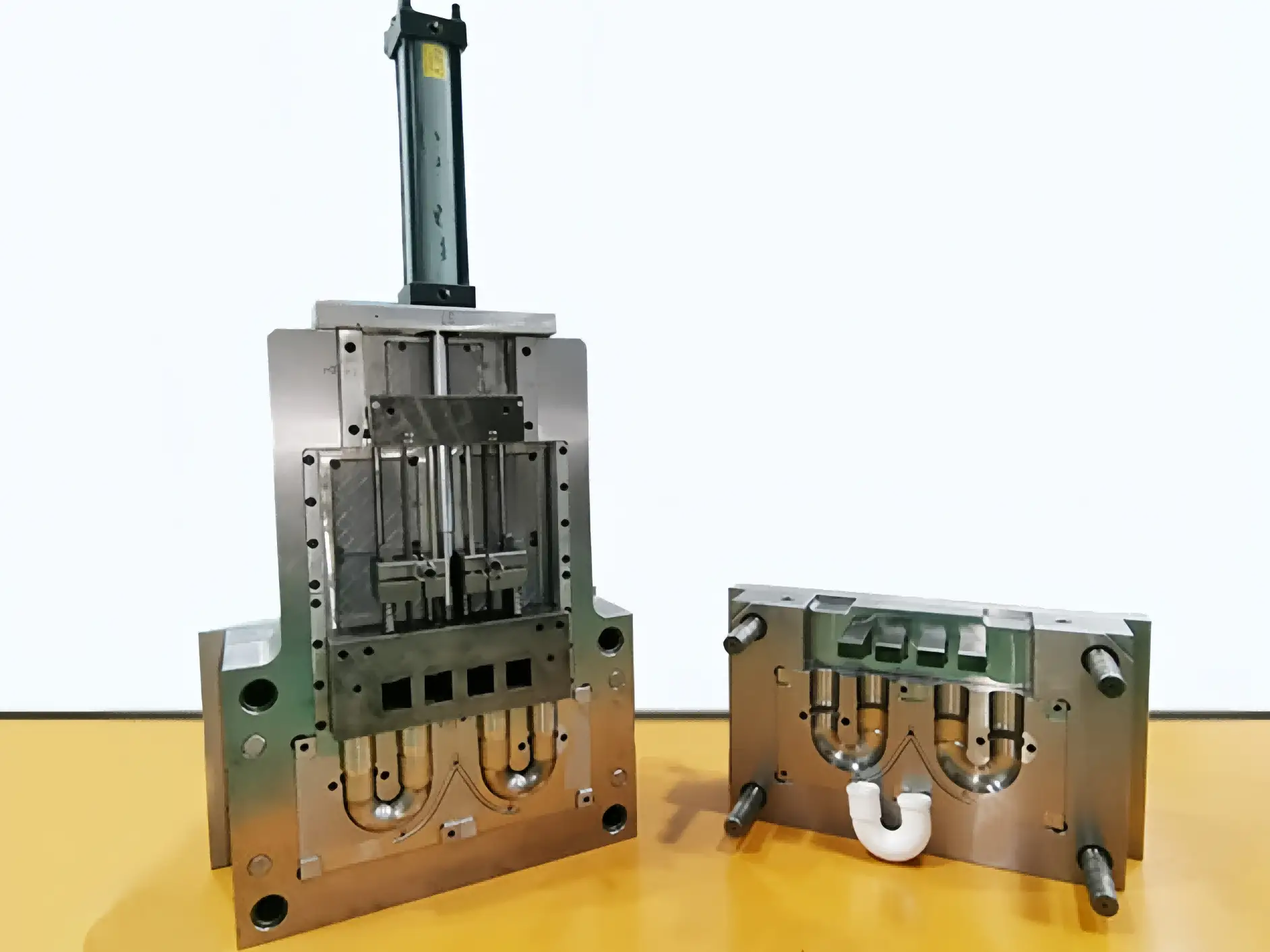
Advanced Tooling Case Study: 1-1/2" PP 180-Degree Elbow Injection Mold
Product Specifications & Structural Challenges
The component is a 1-1/2” PP 180-degree elbow featuring a tight, continuous U-bend and an extended straight run on one end.
The primary engineering challenge lies in the deep 180-degree undercut. Traditional ejection methods for severe bends often rely on complex, space-consuming gear unscrewing mechanisms or heavy multi-axis rotational cores. These approaches increase the mold footprint, elevate maintenance risks, and extend cycle times. A more compact, linear solution was required to maintain efficiency for a 2-cavity cold runner setup.
Kinematics: The Circular-Arc Chain-Link Collapsible Core
To extract the 180-degree geometry without rotational mechanisms, our engineering team implemented a circular-arc chain-link collapsible core.
Instead of a solid rigid core, the 180-degree internal section is segmented into six precisely machined steel arcs. These segments are structurally linked via a high-tensile wire rope and travel along two customized internal guide rails.
- Operational Sequence: During the injection phase, the six segments lock together under pressure to form a seamless 180-degree solid core. During mold opening, a single hydraulic cylinder drives both cavities simultaneously. The linear pull drags the segments along the guide rails, causing the core to flex and collapse smoothly as it extracts from the curved cavity of the molded part.
- Side-Interface Mechanics: For the secondary side interface, the mold utilizes a highly reliable angle pin (horn pin) and slider mechanism, working in tandem with the primary hydraulic pull.
- Thermal Management Workaround: The ultra-compact nature of a segmented folding core means it cannot house internal cooling channels. To compensate and maintain optimal cycle times for the semi-crystalline PP material, an aggressive external cooling circuit was integrated into the cavity blocks immediately surrounding the core interface, ensuring rapid heat dissipation.
Automated Post-Processing: Cavity-Side Submarine Gating
To eliminate secondary manual labor, this 2-cavity mold employs a submarine gate (tunnel gate) located on the cavity side (front mold).
Polypropylene (PP) possesses excellent fatigue resistance and flexibility. By utilizing a sharply angled submarine gate on the front mold, the gate automatically shears off the product the moment the mold opens and the ejection sequence begins. The runner system falls away independently from the finished parts, enabling fully automated, drop-and-pack production lines without the need for operators to manually trim gates.
Tooling Versatility: Interchangeable Inserts for Multiple SKUS
In practical applications, a single type of basic pipe fitting often requires various connection interfaces. Rather than machining two distinct molds, this tooling architecture was designed as a high-efficiency interchangeable mold.
The tool accommodates specialized modular inserts to produce two distinct variations of the 1-1/2" elbow:
- Threaded Interface: For screw-on plumbing connections.
- Barbed Interface: For flexible hose retention.
By standardizing the mold base and the complex chain-link core pulling mechanism, swapping the cavity inserts allows for rapid changeovers between SKUs. This significantly reduces upfront capital expenditure on tooling while providing maximum inventory flexibility.
Material Synergy: Why PP Demands Specific Tooling Considerations
Unlike rigid PVC (which was utilized in our J-Bend fitting projects and requires highly corrosion-resistant steel), Polypropylene is non-corrosive but presents different challenges, notably a higher shrinkage rate (typically 1.5% - 2.0%).
The interlocking tolerances of the six-segment collapsible core were micro-machined to account for PP's specific shrinkage characteristics, ensuring flash-free internal walls. Furthermore, the cavity-side submarine gate was sized perfectly to prevent shear-induced degradation of the PP melt, preserving the structural integrity of the elbow's curve under high fluid pressure.